Showing posts with label OLED. Show all posts

Sunday, November 4, 2018

AP Systems to supply Thin Film Encapsulation to Samsung Display QD-OLED line

DIGITimes China reports [LINK] that Samsung Display is building a large-scale quantum dot organic light-emitting diode (QD-OLED) panel pilot production line. The line is scheduled to be finished in December 2018 and will be activated after 6 months (mid 2019). According to the report the supply ration from Korean equipment manufacturers has increased significantly for this line.

As an example the the report claims that AP Systems beat Applied Materials to supply the Thin Film Encapsulation (TFE) equipment. AP Systems has previously supplied TFE equipment for the 8th generation RGB OLED TV panel production line (V1) of Samsung Display. In the past Samsung Display has used TFE equipment supplied by Applied Materials in the 6th generation flexible OLED production line, but has now switched and for its AP Systems in this 8th generation QD-OLED test production line.

Also according to the report, the PECVD equipment will be supplied by Wonik IPS from Korea whereas the blue OLED material evaporation equipment will be supplied by Canon Tokki (Japan) and the red and green QD material inkjet printing machine will come from Kateeva (USA).
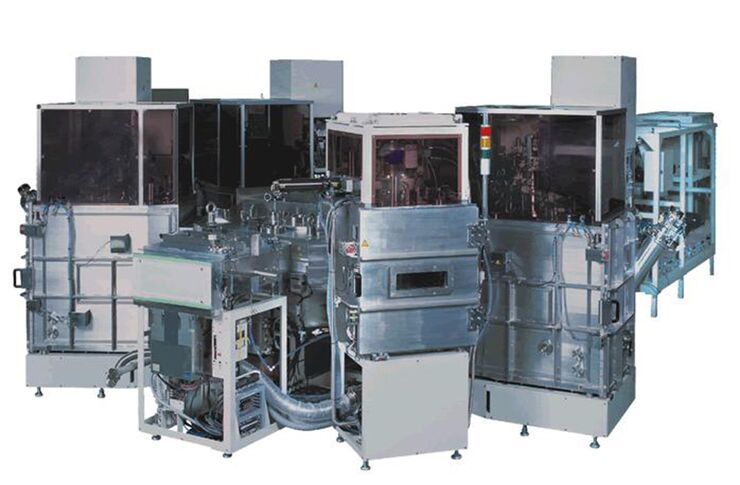
The KORONA™ TFE System running PEALD with "Multi-linear Nozzle" technology and ICP antenna design technology (high density/low damage plasma).
For TFE AP Systems are using a Plasma enhanced Atomic Layer Deposition (PEALD) technology on their KORONA™ TFE System. The system is capable of depositing a film structure that acts as a sealant to prevent oxygen and moisture penetration into OLED device. Based on a 1000Å, SiNx/SiOx multi-layer structure the Water Vapor Permeability is less than 5e-5 g/m2/day.
According to AP Systems they can also apply the film as a flexible sealant to realize flexible, rollable, and foldable displays. 


Monday, October 22, 2018

Shaanxi Kuntech launch flexible semiconductor service manufacturing Base Project

OLED-Info reports: The press conference for the landing and launching of Shaanxi Kuntech Flexible Semiconductor Service Manufacturing Base Project was grandly held in West Fengxi New City, West Xian Xin New District, Shaanxi province on the morning of October 16, with its theme being Shinning Shaanxi and Shaping the Future World".

Kuntech is the first high-end enterprise in China that focuses on the development and autonomy of flexible semiconductors and advanced display technologies. It develops and actively accumulates intellectual property with the highest intensity focus technology, and achieves technology autonomy and freedom to operate. Facing the huge challenges of future display and semiconductor development, Kuntech Semiconductor continues to innovate and advance in the field of flexible semiconductor display through a series of revolutionary technologies.

It is reported that Shaanxi Kuntech flexible semiconductor service manufacturing base is a major science and technology industry project of Shaanxi Province, China. The total investment of the project is 6 billion USD. The project includes a world-class flexible semiconductor and display technology R&D certification center, a strong and complete flexible semiconductor and display industry chain, and the sixth-generation flexible AMOLED demonstration production line with its production capacity being 30K large substrates per month, featuring three major processes (array, AMOLED EL, flexible module). The size of the substrate is 1500mmx1850mm.
Full story : OLED-Info LINK

Saturday, August 18, 2018

BOE to begin trial production of micro-OLED in early 2019 using ALD

[DigiTimes LINK] BOE Technology is making preparations for trial production of micro-OLED panels for AR/VR applications, according to a Korea-based ET News report. The report claims the follwoing:
  • production is planned for Kunming BOE Display Technology - a joint venture between BOE and the provincial government of Kunming in China.
  • BOE has begun purchasing production equipment needed for the plant, including sputters, CVD (chemical vapor deposition), AOI (automated optical inspection) and ALD (atomic layer deposition) equipment, to pave the way for the trial production set in early 2019.
  • Kunming BOE Display aims to roll out one millions units of OLED panels a year with panel sizes ranging from 0.5- to 0.8-inch. 


BOE Technology detailed a USD170 Million investment in China’s First Micro-OLED Plant in Kunming in 2017 [LINK]. According to the news release Chinese OLED tech firm Olightek Opto-Electronic Technology Co. will invest CNY200 million through OLED micro-display related intangible assets and Dianzhong Industry Development Group Co. will put up CNY95 million. Kopin Technology Shenzhen Co., the Chinese subsidiary of major American electronics manufacturer, Kopin Corp., will provide the remaining CNY35 million.

Kopin has entered the OLED microdisplay market for mobile VR and AR with new technology and business model as a fully Fabless company using foundries for manufacturing. Please check here for a review [LINK]


Tuesday, March 6, 2018

Applied Materials see high growth for Display business >30% growth

Applied Materials, Inc. (AMAT) recently reported record revenue and operating profit in its first quarter ended January 28, 2018. Besides beeing the big giant for wafer equipment they are also in the lead for display, for TV as well as smartphone and especially for the lastets size 10.5 Gen.

According the the recent news covered by Seeking Alpha (LINK), Applied Materials is counting on revenue growth from 10.5G LCD plants and from its operations in LTPS backplanes and OLED encapsulation, primarily for the smartphone sector.

In the recent 1Q 2018 earnings call - Gary E. Dickerson - Applied Materials said: "In Display, there are two equally large market inflections driving capital investments: the introduction of Gen 10.5 substrates for TV manufacturing and organic LED displays. In mobile, the transition to OLED displays is compelling. This is because rigid OLED offers significant performance, power and cost advantages over LCD, and flexible OLED will enable new form factors, such as curved and eventually foldable screens. As a result, our positive outlook for 2018 and beyond remains unchanged. Display is a unique growth driver for Applied, and we expect to increase our revenue by more than 30% in 2018 on top of nearly 60% growth last year."
Dickerson further stated:
  • year-over-yearoutlook for Display business is greater than 30% growth, and 2019 and beyond also look very strong.
  • for mobile versus TV Applied Materials has an about 50/50 mix. In TV, they see increased adoption of larger screens and they are tracking 13 Gen 10.5 projects. As an example if you produce 65-inch TVs with Gen 10.5, you get eight 65-inch TVs per plane and only three with Gen 8.5 and driving the TV business.

Chart above from IHS (thru SeekingAlpha, LINK) shows planned equipment purchases for 10.5G quipment, install dates, and production ramp up.


Applied Materials AKT-PECVD covers the complete range of glass sizes used in the display industry from Gen 2 (0.2m2) all the way up to Gen 10 (9m2). The systems offer processes for both amorphous silicon (a-Si) and metal oxide (MOx) backplane technologies. Available films include both doped and undoped (a-Si), silicon oxide (SiOx), silicon oxynitride (SiON), silicon nitride (SiN), and in-situ multi-layer deposition. (appliedmaterials.com)
According to Seeking Alpha the maine cometitors for current technologies (<10.5 Gen) are :
For the TFT Backplane:
  • PECVD companies - AMAT, Jusung Engineering (Korea), and Wonik IPS (Korea)
  • PVD companies - AMAT, Avaco (Korea), Iruja (Korea), and Ulvac (Japan)
  • Laser Anneal companies – Coherent, AP Systems (Korea), Japan Steel Works (Japan)
For the OLED Encapsulation:
  • Jusung Engineering (Korea)
  • Wonik IPS (Korea)
  • TES (Korea)
These Korean companies all have ALD technologies and equipment for displays. The advantages with ALD are:
  • thin films offer better water and oxygen protection
  • a thinner film is needed to provide the same protection as thicker PECVD-coated films
  • the slower coating process by ALD is compensated by a thinner film 

Sunday, February 11, 2018

Apple, LG, Valve bet on OLED microdisplays technology, invest $10 million in eMagin

TechObserver reports : Maker of OLED microdisplays eMagin is getting attention from tech giants such as Apple and LG as they bet big on VR and AR for future growth. According to documents filed with the US Securities and Exchange Commission Apple, LG and Valve have made $10 million investment in eMagin.

eMagin is New York-based company that makes microdisplays used in the military, medical and industrial fields, but it has recently turned its attention to companies building consumer headsets. "We entered into strategic agreements with multiple Tier One consumer product companies for the design and development of microdisplays for consumer head mounted devices and, together with these companies, negotiated with mass production manufacturers for higher volume production capabilities," eMagin said in its filing.

Article: LINK

The company's flagship product is a 2K display with a resolution of 2,048x2,048 pixels and a 70 percent fill factor, the percentage of each pixel that can be used to gather light. (Picture from OLED-Info LINK)

Thursday, July 27, 2017

Memory chip boom - Samsung Q2 operating profit up 73 percent

Samsung Electronics said a memory chip boom that propelled it to record profit in the second quarter is likely to continue in the third, just as revenue is widely expected to benefit from sales of OLED screens to Apple.

The world’s biggest maker of memory chips, smartphones and TVs is set to smash its annual profit record after better-than-forecast performance in its mobile business lifted April-June profit slightly above its early-July guidance, analysts said.

“Looking ahead to the third quarter, the company expects favorable semiconductor conditions to continue,” Samsung said in a statement on Thursday. “Although overall earnings may slightly decline quarter-on-quarter as earnings weaken for the display panel and mobile businesses.”

Source: VentureBeat LINK

Flexible AMOLED capacity to almost double each year until 2020

OLED-Info reports that estimates by IHS that flexible AMOLED production capacity is set to increase from 1.5 million square meters to 20.1 million square meters between 2016 and 2020, which would correspond to a compound annual growth rate of 91%.

Source: OLED-Info (LINK)


The Korean CVD & ALD OEMs stocks are travelling upwards since April 2017 (see below). Surely based on investments by Samsung and SK Hynix for Foundry, DRAM and 3D-NAND but this must also reflect order intake from Korean and Chinese AMOLED 6 Gen lines to some extent.

Recent announcments for Semi orders:

Tes signed 16.75 billion won contract with Samsung Electronics Co Ltd, to provide semiconductor manufacturing system (LINK

Eugene Technology signed a 7.36 billion won contract with SK hynix to provide semiconductor manufacturing equipments (LINK)

Tes signed a 2.8 billion won contract with SK hynix Inc to provide semiconductor manufacturing equipment . (LINK)


Monday, July 24, 2017

Apple to setup a 2.5-Gen OLED R&D production line in Taiwan

According to OLED-Info referring to reports from Korea, Apple ordered a 2.5-Gen OLED evaporation (CVD) equipment from Sunic System in order to build an OLED pilot line in Taiwan. The report suggests that Apple wants to develop in-house OLED technologies which will allow it to reduce its reliance on Samsung Display.


Friday, June 16, 2017

Samsung Display seeks final approval for its $7 billion A4 flexible OLED fab

Samsung Display seeks final approval for its $7 billion A4 flexible OLED fab, which will start making flexible OLEDs in 2019

Source: OLED-Info LINK

Thursday, April 13, 2017

AIXTRON and major Asian OLED display manufacturer collaborate on production qualification of deposition technology

AIXTRON SE (FSE: AIXA; OTC: AIXNY), a worldwide leading provider of deposition equipment to the semiconductor industry, received a purchase order from a leading Asian OLED display manufacturer for a deposition system to be installed at the customer site within the second half of 2017. The collaboration targets the qualification of AIXTRON’s technology for the production of OLED displays.


Andreas Toennis, Group Head New Technologies at AIXTRON, comments: “With the number of applications for OLEDs steadily growing, this is an important milestone in the commercialization of our deposition system technology. We are looking forward to further improve our systems and processes in close collaboration with our customer.”

AIXTRON’s deposition system technology offers unique advantages by enabling highest deposition rates, minimizing the risk of degradation of organic material through its STExS (Short Thermal Exposure Source) technology, providing best organic material utilization efficiency as well as excellent thickness uniformity and reproducibility. In combination with AIXTRON’s patented Close Coupled Showerhead (CCS) technology, the thin-film deposition of organic small molecules can be scaled to any degree and any substrate dimension. Furthermore, AIXTRON’s gas phase transport allows for more precise control of the deposition rates and thus enhanced flexibility in manufacturing complex structures. 
Press release: LINK

Tuesday, April 11, 2017

Google wants LG Display flexible OLED production for their next gen Pixel phone

OLED-Info reports that Google wants to invest $872 million in LG Display to help secure flexible OLEDs for its next-gen Pixel phone (Original source ETNews).

 
Reportedly, LG Display is ramping two flexible OLED fabs, which of one is a 6-Gen flexible OLED fab in Gumi (OLED-Info:E5 line). In addition, a 3rd Gen-6 fab (E6) may start in 2018.

According to reports (LINK), Samsung monitors and LG Display are preparing to use ALD technology in flexible OLED production processes. Jusung Engineering, WONIK IPS, AP System and TES have ALD technology and equipment for Gen 6. Out off the European ALD OEMs Enapsulix and Beneq is also supplying ALD for OLED Encapsulation.

Much more details on this story at OLED-Info: LINK.

So what about ALD? There is no way to tell if those lines have ALD Encapsulation technology but flexible Gen-6 OLED has been reported to use ALD in some cases and all those South Korean ALD encapsulation clusters being shipped has to end up somewhere. 

The ALD OLED Encapsulation equipment market is in its early stage trailing the ALD Semiconductor ALD market by 10 years or so at total size of one order of magnitude smaller than the single & multi-wafer ALD equipment market.

When it comes to ALD precursors it is not too exciting yet since the barriers are mainly Al2O3, sometimes laminated byTiO2. However, there are recent publications showing promising barrier properties employing some of the High-k metal oxides used in the Logic Gate stack and DRAM capacitors.

What is exciting though is the ALD process chamber technology that has been developed in this field. Everything from Large Panel Batch Reactors, Ultra Fast cross flow reactors and Spatial ALD. This is were all the fun is!


Wednesday, February 8, 2017

Digitimes Research: China makers aggressively expanding AMOLED capacity

Digitimes Research reports: "Seven China-based panel makers have been expanding existing or setting up new AMOLED production capacities, with total annual capacity estimated to increase from 272,000 square meters in 2016 to 1.584 million square meters in 2018, 4.464 million square meters in 2019, and 7.864 million square meters in 2020 at a 2016-2020 CAGR of 131.9%, according to Digitimes Research."
 
 
Royole’s Flexible Display : Since inception, we have dedicated ourselves to the development of innovative flexible display technologies and applications, covering novel materials, processes, circuits, manufacturing tools and others, which enabled us to demonstrate the world’s thinnest (0.01 mm) full-color flexible display with 1.00 mm bending radius. (www.royole.com)

Samsung Display and LG Display is still well in the lead now and will stay so also until 2020. However, a transition to flexible AMOLED by the South Korea based companies is ongoing (46.1% in 2016 to 72.6% in 2020).
 
2016 to 2020 AMOLED Production

South Korea: 4.945 to 15.130 million square meters
China: 272,000 to 7.864 million square meters
 
If ALD will make progress in this market the market will be very big and lead to big investments in ALD equipment and enhanced world consumption of ALD precursors like TMA.
 
Chinese display companies mentioned in the report: BOE Technology, Tianma Micro-electronics, Visionox, EverDisplay Optronics, China Star Optoelectronics Technology, Truly Opto-Electronics and Royole

Thursday, December 22, 2016

Applied Materials reportedly missing out on ALD for OLED encapsulation

Applied Materials is world leading in CVD processing for wafer and display. However, i big part of the CVD equipment market today is the booming segment of ALD where Applied only have single digit percentage of the revenue. According to a recent report by Seeking Alpha, "Applied Materials is facing strong competition as its deposition technology is being supplanted by Atomic Layer Deposition at Samsung Electronics and LG Display". Other applications where Applied Materials did not enter with ALD include:
  • DRAM High-k MIM Capacitors
  • Logic High-k Metal Gate Stack 
  • Double Patterning 
However, Applied Materials has reported strong revenue in Selective Etch and Olympa ALD (>USD 230M) Possibly they have some advanced Spatial ALD technology up the sleeve also for OLED encapsulation.

 Watch For Big Display Equipment Cancellations Coming From Applied Materials

  • Tight supply of a critical piece of OLED equipment from Canon Tokki will limit OLED production in 2017 and impact Applied Material's sales of supplemental equipment.
  • Applied Materials also is facing strong competition as its deposition technology is being supplanted by Atomic Layer Deposition at Samsung Electronics and LG Display.
  • As much as $1 billion in display equipment from Applied Materials could be cancelled in 2017.
Full report

More details on the Canone Tokki and Apple OLED roll out story here from Bloomberg:

Apple's Search for Better iPhone Screens Leads to Japan's Rice Fields [Bloomberg TV]

The ELVESS OLED mass production system. Source: Canon Tokki Corp.

Monday, December 12, 2016

Flexible displays to grow 135% in 2017 and are expected to reach 139 million units

IHS Markit reports: As more smartphone manufacturers build designs using flexible display technology, shipments of flexible displays are expected to reach 139 million units in 2017, an increase of 135 percent compared to 2016. Further, the flexible displays are expected to comprise 3.8 percent of total display unit shipments in 2017.
  • Vivo and Xiaomi launched their first smartphones with flexible active-matrix organic light-emitting diode (AMOLED) displays in 2016.
  • Apple is expected to launch its new iPhone using flexible AMOLED display in 2017.
  • In 2017 Samsung Display and LG Display will start operating new fabs for flexible displays.
 Flexible display shipment forcast (Source IHS Markit)

Thursday, September 29, 2016

Samsung & LG Move To ALD for OLED encapsulation may push Applied Materials out of the market

Here is a recent follow up on the rumor that Samsung Electronics and LG Display will move to ALD Encapsulation (and drop PECVD) from Seeking Alpha (Summary below) : LINK
  • Samsung Electronics and LG Display have indicated a move to atomic layer deposition for encapsulation of flexible OLED displays.
  • Applied Materials makes competing equipment and the move by these OLED titans will eliminate the need for equipnent from Applied Materials.
  • Veeco may be the main beneficiary as Samsung has been developing its encapsulation process on Veeco equipment.

Friday, September 23, 2016

Rumor: Apple 2017 iPhone may have Samsung's new Flexible OLED made by ALD

Here are some unconfirmed information that ALD will be used in the next generation Apple iPhone as of 2017.In addition, Korea IT News is claiming that both Samsung and LG have finalized the R&D phase of introducing ALD barrier technology for OLED and are now working closely with Korean ALD OEMs to go to production. Companies mentioned are Jusung Engineering, WONIK IPS, AP System, and TES.

With Apple reportedly shifting to iPhones with OLED displays starting in 2017, it will be interesting to see if Apple will be using Samsung's latest OLED technology that may be ready for the 2017 anniversary iPhone. According to a new OLED report, Samsung Display and LG Display are working to introduce ALD (Atomic Layer Deposition) technology to flexible OLED thin-film encapsulation process. They both have worked closely with their equipment partners to get them up to speed. ALD technology will add an important component to OLED displays for smartphones that add protecting organic materials from oxygen and water that will increase the overall life of a display. Samsung in particular is reported to be "working fast to introduce ALD technology." 
LINK: http://www.patentlyapple.com/patently-apple/2016/09/apples-2017-iphone-may-use-samsungs-new-flexible-oled-atomic-layer-deposition-technology.html

Checking the Korean ALD companies on the stockmarket give no hint or reaction that any of them are about to sign big deals.


Last 6 months performance for an index based on Korean companies with ALD Technology that may be used for OLED Encapsulation. Tes Co Ltd, Jusung Engineering Co., Ltd., EugeneTechnology Co Ltd and Wonik IPS Co Ltd. (Plotted using Google Finance)

Tuesday, September 20, 2016

Jusung Engineering signs contract with LG Display worth 38.27 bln won

BRIEF : Jusung Engineering Co Ltd : Says it signs contract with LG Display Co., Ltd., to provide display manufacture equipment .Contract amount of 38.27 billion won. [REUTER]
 Jusung Engineering Display offering (LINK)